New Hampshire Power of Attorney (Financial) (2026)
Appoint an agent to handle your money, property, banking, investments, business, taxes and benefits — durable or springing, general or limited, with co-agents and successors, express authority for gifts, trusts and beneficiary changes, an agent's acceptance page, and your state's witness, notary, notice and recording rules built in.
 View larger
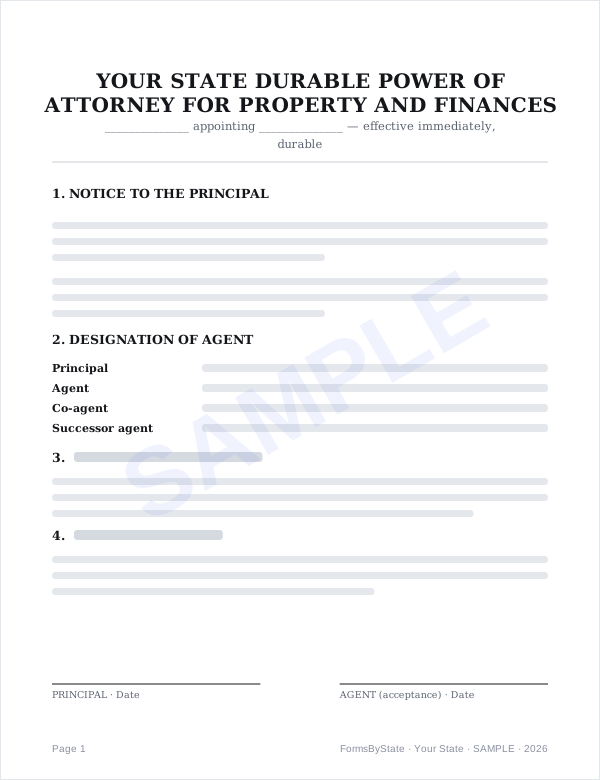
Sample first page of the Power of Attorney (Financial). Your answers fill in the blanks; the clauses required in New Hampshire are added automatically.
- Word
This preview updates as you type. Blank fields show as ____ .
What this document covers
- Principal, agent, co-agents and successor agents
- Durable or non-durable authority
- Effective immediately or on incapacity, with physician certification
- General authority or only the subject areas you pick
- Thirteen subject areas drafted in full
- Express grants for gifts, trusts, beneficiary and survivorship changes
- Annual gift limit and permitted recipients
- Agent's duties, standard of care and record-keeping
- Compensation, reimbursement and accounting
- Third-party reliance and hold-harmless clause
- Revocation of prior powers of attorney
- Signature block with your state's witness and notary rules
- Agent's Certification and Acceptance page
- Statutory notice pages where your state prescribes them
New Hampshire rules that this document follows
Rules current as of 2026-09-14. Statutes change; verify before relying on them.
How to use this Power of Attorney (Financial) in New Hampshire
Start with the people: your full legal name as it appears on your accounts and deeds, one agent you would trust with a blank check, and at least one successor agent. Decide whether the power of attorney is general — every subject area at once — or limited to the areas you tick. Then handle the sensitive powers separately: gifts, trusts, beneficiary and survivorship changes, delegation and disclaimers reach your agent only if you grant them expressly, with an annual gift limit and a list of permitted recipients. New Hampshire publishes a statutory form at N.H. Rev. Stat. Ann. § 564-E:301, and its use is optional.
Choose durable so the authority survives your incapacity, and decide when it starts. At signing, sign before a notary (N.H. Rev. Stat. Ann. § 564-E:105). Keep the Agent's Certification and Acceptance page with the document, give a copy to each bank and broker now rather than in a crisis, and remember that this document does not cover medical decisions: for those New Hampshire uses the Durable Power of Attorney for Health Care (N.H. Rev. Stat. Ann. § 137-J:19). Record it in the county land records if your agent will sign anything affecting real estate (N.H. Rev. Stat. Ann. § 564-E:101 et seq.).
Frequently asked questions
Does a power of attorney have to be notarized in New Hampshire?
Yes. New Hampshire requires the principal's signature to be acknowledged before a notary public (N.H. Rev. Stat. Ann. § 564-E:105). In practice notarize every power of attorney: banks, brokers and county recorders will not take an unnotarized one.
Can I sign a power of attorney that only starts if I become incapacitated?
Yes. New Hampshire allows a power of attorney to become effective on your incapacity (N.H. Rev. Stat. Ann. § 564-E:109). The cost is delay: before the agent can act, a physician must put the determination in writing and the bank must accept it, which can take weeks at exactly the wrong moment. Most planners choose an immediate power of attorney given to a person they trust, rather than a springing one.
Does New Hampshire have a statutory power of attorney form?
Yes — N.H. Rev. Stat. Ann. § 564-E:301. Its use is optional: any instrument that meets the execution requirements is valid. This document tracks the statutory categories so institutions in New Hampshire recognize it.
Can my agent give my money away?
Only if this power of attorney says so. New Hampshire lists 8 acts that require an express grant of specific authority, including gifts and changes to beneficiary designations and survivorship rights (N.H. Rev. Stat. Ann. § 564-E:201). Without a different figure the limit is the federal annual gift tax exclusion per recipient. The wizard prints a separate signature line next to each sensitive power you grant.
Does this document cover medical decisions?
No. This document is financial only. In New Hampshire health care decisions are delegated in a separate instrument, the Durable Power of Attorney for Health Care (N.H. Rev. Stat. Ann. § 137-J:19). Sign both: the financial power of attorney for money and property, and the health care instrument for treatment decisions, and give each to the people who need it.
Can a bank refuse my power of attorney in New Hampshire?
Not without a reason the statute allows. A person asked to accept an acknowledged power of attorney must accept it or request an agent's certification, an English translation or an opinion of counsel within seven business days, and must accept it within five business days after the requested item arrives. An unreasonable refusal exposes the refusing person to a court order and to the principal's attorney fees. If the branch still refuses, ask for the refusal in writing, send the agent's certification and affidavit printed with this document, and point to N.H. Rev. Stat. Ann. § 564-E:120.
Do I have to record a power of attorney in New Hampshire?
Record it when your agent will sign anything affecting real estate. A power of attorney used to sign a deed, mortgage or other instrument affecting real property must be recorded in the land records of the county where the property lies, normally before or together with the instrument the agent signs. You do not need to record a power of attorney that is only used for banking. A recorded power of attorney also gives a title company a clean chain of authority.
Other names
- power of attorney
- financial power of attorney
- durable power of attorney
- general power of attorney
- limited power of attorney
- POA form
- statutory power of attorney
- springing power of attorney
- attorney-in-fact form
- agent authorization form
Related documents
- Room Rental Agreement — New Hampshire
- Rental Application — New Hampshire
- Bill of Sale — New Hampshire
- Promissory Note — New Hampshire
Other states
- Alabama
- Alaska
- Arizona
- Arkansas
- California
- Colorado
- Connecticut
- Delaware
- District of Columbia
- Florida
- Georgia
- Hawaii
- Idaho
- Illinois
- Indiana
- Iowa
- Kansas
- Kentucky
- Louisiana
- Maine
- Maryland
- Massachusetts
- Michigan
- Minnesota
- Mississippi
- Missouri
- Montana
- Nebraska
- Nevada
- New Jersey
- New Mexico
- New York
- North Carolina
- North Dakota
- Ohio
- Oklahoma
- Oregon
- Pennsylvania
- Rhode Island
- South Carolina
- South Dakota
- Tennessee
- Texas
- Utah
- Vermont
- Virginia
- Washington
- West Virginia
- Wisconsin
- Wyoming
FormsByState provides self-help document templates and general information, not legal advice. We are not a law firm. For advice about your situation consult a licensed attorney in your state.
Download your document
Power of Attorney (Financial)
One-time payment. No subscription, no card on file, no trial.
Single document
$19 one-time
- PDF + Word, no watermark
- Unlimited edits for 90 days
- State-specific disclosures included
7-day pass
$14.99 one-time
- Every document for 7 days
- Unlimited downloads
- Never renews — ends automatically
Pro
$19 /month
- Unlimited documents and downloads
- All 51 jurisdictions
- Cancel in one click
Secure checkout by Stripe. 30-day money-back guarantee.
Already purchased? Your access is restored automatically on this device or after signing in.