District of Columbia Last Will and Testament (2026)
Say who gets what, who raises your children and who settles your estate — specific and cash gifts with an anti-lapse fallback, a residuary clause, a guardian and an alternate, a trust that holds a minor's share until the age you choose, an executor serving without bond, a pet trust, digital-asset access, the attestation clause and your state's own self-proving affidavit, with step-by-step signing instructions for your state.
 View larger
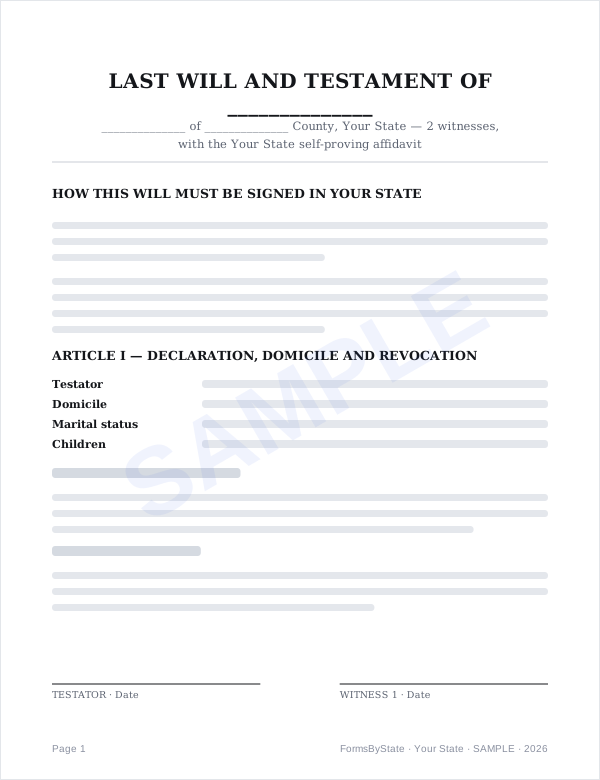
Sample first page of the Last Will and Testament. Your answers fill in the blanks; the clauses required in District of Columbia are added automatically.
- Word
This preview updates as you type. Blank fields show as ____ .
What this document covers
- Testator, domicile and revocation of every earlier will
- Spouse, children and an after-born (pretermitted) child clause
- Debts, funeral expenses and tax apportionment
- Specific bequests with an anti-lapse fallback for each gift
- Cash bequests and charitable gifts
- Residuary estate, per stirpes or per capita, with a contingent taker
- Guardian of the person and guardian of the estate, plus alternates
- Testamentary trust that holds a minor's share to the age you choose
- Health, education, maintenance and support (HEMS) standard and trustee powers
- Executor and alternate, serving without bond where the state allows
- Power to sell real property without a court order
- Pet trust with a caretaker and a fund
- No-contest clause where your state enforces it
- Survivorship period and simultaneous-death clause
- Digital-asset authority under the RUFADAA
- Attestation clause and your state's self-proving affidavit
- A separate How to sign this will page for your state
District of Columbia rules that this document follows
Rules current as of 2026-09-14. Statutes change; verify before relying on them.
How to use this Last Will and Testament in District of Columbia
Start with the people and work outwards. Your full legal name and the county you are domiciled in decide which court opens your estate. Name your spouse and every child, including a child you are deliberately leaving out — an unnamed child is presumed forgotten and takes an intestate share off the top. Then list only the gifts that would otherwise cause an argument: the house, the ring, the business. Everything else belongs in the residuary clause, which catches the accounts you open next year and the gifts that fail.
Decide the two questions that matter most for a family: who raises your minor children, and at what age they get the money. A guardian of the person raises the child; a guardian of the estate handles the child's money; a trust holds the share to 25 or 30 with a health, education, maintenance and support standard in the meantime, instead of handing a teenager the whole inheritance on an eighteenth birthday. Name an alternate for every role — the commonest reason an estate stalls is that the only named person has died or declined.
Then sign it properly, because that is where wills fail. In District of Columbia you sign in front of 2 witnesses who are at least 18 and who inherit nothing (D.C. Code § 18-103). District of Columbia has no self-proving affidavit (D.C. Code § 18-103), so keep a note of each witness's name, address and telephone number with the will. Do not use a beneficiary as a witness: District of Columbia cuts down or voids the gift (D.C. Code § 18-104). Full step-by-step instructions print on their own page at the end. Then keep the signed original where your executor can reach it, and review the will after a marriage, a divorce, a birth, a death or a move to another state.
Frequently asked questions
How many witnesses does a will need in District of Columbia?
2 witnesses, each at least 18 years old (D.C. Code § 18-103). The witnesses must sign in the testator's presence, within a reasonable time after witnessing the signing or the testator's acknowledgment of the signature. A will signed with fewer witnesses than the statute requires is not admitted to probate, and the estate passes under the intestacy statute instead.
Does the will have to be notarized?
No, and it would not help. District of Columbia does not use a notary on a will at all (D.C. Code § 18-103); a notarized will is no more valid here than an un-notarized one.
Is a handwritten will valid in District of Columbia?
No. District of Columbia does not admit a handwritten, unwitnessed will (D.C. Code § 18-103). Even where one is allowed it is the weakest kind of will: there is nobody to say you were of sound mind, the handwriting has to be proved, and courts read informal documents strictly. This document is a typed, witnessed will, which is admitted everywhere.
What is a self-proving affidavit and do I need one?
District of Columbia does not have one (D.C. Code § 18-103). The District has no self-proving affidavit for a paper will. A will is proved in the Probate Division on the testimony or the sworn Affidavit of Witness to Will taken after the testator's death. Self-proving at the moment of execution exists only for electronic wills (D.C. Code § 18-908). Keep a note of each witness's name, address and telephone number with the will, because your executor will have to produce one of them.
Can I leave my spouse out of my will?
You can write the will that way, but it will not hold. Your spouse may elect against the will and take 50% instead (D.C. Code § 19-113).
Does a no-contest clause work in District of Columbia?
Partly. District of Columbia enforces the clause, but not against a beneficiary who brings the challenge in good faith and on probable cause (D.C. Code tit. 18). It stops a nuisance contest; it does not stop a well-founded one.
Can my executor live in another state?
Yes. District of Columbia puts no residence requirement on an executor, and the waiver of bond in this will is honored in the ordinary case (D.C. Code § 20-303).
Can I sign the will electronically?
District of Columbia does recognize electronic wills (D.C. Code § 18-901 et seq.), but they run on a separate track: a qualified custodian, a specific audit trail and, in most of those statutes, remote witnessing by audio-video link. This document is a paper will, so print it and sign it in ink. Whatever your state allows, the original signed paper is what the probate court wants to see — a scan or a photograph is not a substitute.
Where should I keep the signed will?
Somewhere your executor can reach it within a day of your death, and not in a safe-deposit box that is sealed when you die. A fireproof box at home, your attorney's file, or the probate court's own will deposit where your state offers one. Tell your executor where it is and give the executor a copy. Do not write on the original after signing: a crossed-out name or a marginal note does not change the will and can raise a question about whether you revoked it.
Other names
- last will and testament
- will
- simple will
- will form
- testament
- last will
- estate will
- will and testament template
- printable will
- will with trust for minors
Related documents
- Room Rental Agreement — District of Columbia
- Rental Application — District of Columbia
- Bill of Sale — District of Columbia
- Promissory Note — District of Columbia
Other states
- Alabama
- Alaska
- Arizona
- Arkansas
- California
- Colorado
- Connecticut
- Delaware
- Florida
- Georgia
- Hawaii
- Idaho
- Illinois
- Indiana
- Iowa
- Kansas
- Kentucky
- Louisiana
- Maine
- Maryland
- Massachusetts
- Michigan
- Minnesota
- Mississippi
- Missouri
- Montana
- Nebraska
- Nevada
- New Hampshire
- New Jersey
- New Mexico
- New York
- North Carolina
- North Dakota
- Ohio
- Oklahoma
- Oregon
- Pennsylvania
- Rhode Island
- South Carolina
- South Dakota
- Tennessee
- Texas
- Utah
- Vermont
- Virginia
- Washington
- West Virginia
- Wisconsin
- Wyoming
FormsByState provides self-help document templates and general information, not legal advice. We are not a law firm. For advice about your situation consult a licensed attorney in your state.
Download your document
Last Will and Testament
One-time payment. No subscription, no card on file, no trial.
Single document
$19 one-time
- PDF + Word, no watermark
- Unlimited edits for 90 days
- State-specific disclosures included
7-day pass
$14.99 one-time
- Every document for 7 days
- Unlimited downloads
- Never renews — ends automatically
Pro
$19 /month
- Unlimited documents and downloads
- All 51 jurisdictions
- Cancel in one click
Secure checkout by Stripe. 30-day money-back guarantee.
Already purchased? Your access is restored automatically on this device or after signing in.