New York Construction Change Order (2026)
A signed amendment to a construction or home improvement contract: what changes, what it adds to or deducts from the price, the revised contract sum, how many days it adds to the schedule, and confirmation that everything else in the contract stays the same.
 View larger
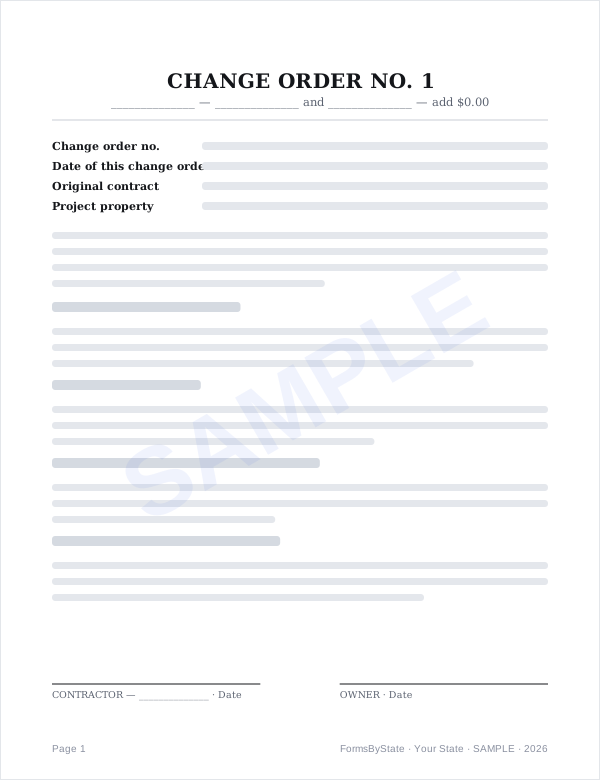
Sample first page of the Construction Change Order. Your answers fill in the blanks; the clauses required in New York are added automatically.
- Word
This preview updates as you type. Blank fields show as ____ .
What this document covers
- Change order number and the contract it amends
- Contractor, licence number and owner
- Project address and the date of the original contract
- What changes, in the owner's and the contractor's words
- Why it changes — owner request, hidden condition, code or design
- Itemized pricing or a lump sum, added or deducted
- Revised contract sum after every previous change order
- Days added to the schedule and the new completion date
- Payment terms for this change alone
- Confirmation that every other contract term stays in force
New York rules that this document follows
| Written change order required | Not required by a confirmed statute — a written, signed amendment is still the only reliable proof of the changeSource: Common law of contracts; state statute of frauds |
|---|---|
| Signature before the changed work | No confirmed statutory rule; sign before the changed work starts so the extra is not disputed laterSource: Common law of contracts; state statute of frauds |
| Price and schedule in the order | No confirmed statutory content rule — state both the price effect and the schedule effect anywaySource: Common law of contracts; state statute of frauds |
| Payment for the change | Every progress payment must bear a reasonable relationship to the amount of work to be performed, the materials to be purchased or the expenses the contractor is obligated for at the time of payment, which limits what may be collected up front for a change.Source: N.Y. Gen. Bus. Law § 771(1)(f) |
| Licence number on the paperwork | Required on the home improvement contract, so it is printed on the change order too — county or city licensing agency (New York City, Nassau, Suffolk, Westchester, Rockland or Putnam)Source: N.Y. Gen. Bus. Law § 771(1)(a) |
| Lien rights for the extra work | Work added by a signed change order is lienable: it counts as labor and materials furnished for the improvement under this state's mechanics lien chapter.Source: N.Y. Lien Law art. 2, §§ 3 et seq. (mechanics' liens) |
Rules current as of 2026-09-14. Statutes change; verify before relying on them.
How to use this Construction Change Order in New York
No statewide home improvement rule requiring a written change order was confirmed for New York, so the contract's own change clause and the general law of contracts decide the question (Common law of contracts; state statute of frauds). A change order is not a new contract: it names the original contract and its date, describes exactly what changes, prices the change, and says what it does to the completion date. Everything the contract said before stays in force unless this document changes it.
Price the change the way the owner can check it. Line items — quantity times unit price, labour and materials separated — are what survive a dispute; a lump sum belongs on small, obvious work. Say plainly whether the amount is added to the contract or deducted from it, then carry the arithmetic all the way through: original contract sum, plus the net of every earlier change order, plus or minus this one, equals the revised contract sum. That last number is the only price that should appear on the next invoice, on the lender's draw request and in any lien claim.
Deal with time and money in the same document. Write the schedule effect in whole days, even when it is zero — leave it blank and the original completion date usually still binds, which is how a contractor ends up late because of a change the owner asked for. On payment, New York law is specific: Every progress payment must bear a reasonable relationship to the amount of work to be performed, the materials to be purchased or the expenses the contractor is obligated for at the time of payment, which limits what may be collected up front for a change. (N.Y. Gen. Bus. Law § 771(1)(f)) A deposit for special-order or custom material is the one sensible exception.
Sign before the changed work starts, and give the owner a copy the same day. Signing first is what makes the order provable: the file shows the price was agreed before anyone swung a hammer, not negotiated afterwards. Print the contractor's licence number on the amendment as well, because New York requires it on the contract this document becomes part of (N.Y. Gen. Bus. Law § 771(1)(a)). Keep the signed order with the contract, the invoices and the lien waivers — together they are the whole story of what the job cost.
Frequently asked questions
Does New York require a change order to be in writing?
No statewide home improvement statute requiring a written change order was confirmed for New York. The general law of contracts applies: an oral change to a written contract is provable only by testimony, and where the contract itself says changes must be written and signed, that clause is enforced (Common law of contracts; state statute of frauds).
Can a contractor bill for extra work with no signed change order?
Sometimes, on an unjust-enrichment theory, but it is the weakest claim in construction: the contractor has to prove the owner asked for the extra, knew it was not free and accepted it. A signed order takes ten minutes and removes the whole question.
When is the change order money due?
Every progress payment must bear a reasonable relationship to the amount of work to be performed, the materials to be purchased or the expenses the contractor is obligated for at the time of payment, which limits what may be collected up front for a change. (N.Y. Gen. Bus. Law § 771(1)(f)) In practice that means the change is billed as the changed work is performed, on the schedule this form sets out.
Does a change order have to state the new completion date?
Even where no statute says so, leave it out and the original date usually still binds, so a contractor can be late on a deadline the owner's own change made impossible. Write the days, even when the answer is zero.
Can extra work be included in a mechanics lien?
Yes — work added by a signed change order is labor and materials furnished for the improvement under N.Y. Lien Law art. 2, §§ 3 et seq. (mechanics' liens). The signed order is what proves both the scope and the amount, so keep it with the contract and the invoices; an unsigned extra is the claim owners defeat most often.
Do I need the licence number on the change order?
In New York the licence number is required on the home improvement contract itself (N.Y. Gen. Bus. Law § 771(1)(a)), and a change order becomes part of that contract, so print it here too — this form does it for you.
Other names
- change order
- construction change order
- contract amendment contractor
- extra work order
- change order form
- work order change
- variation order
- contract modification construction
- remodel change order
- addendum to construction contract
Related documents
- Construction Lien Waiver and Release — New York
- Residential Construction Contract (Home Improvement) — New York
- Construction Subcontractor Agreement — New York
- Certified Payroll (Form WH-347) — New York
Other states
- Alabama
- Alaska
- Arizona
- Arkansas
- California
- Colorado
- Connecticut
- Delaware
- District of Columbia
- Florida
- Georgia
- Hawaii
- Idaho
- Illinois
- Indiana
- Iowa
- Kansas
- Kentucky
- Louisiana
- Maine
- Maryland
- Massachusetts
- Michigan
- Minnesota
- Mississippi
- Missouri
- Montana
- Nebraska
- Nevada
- New Hampshire
- New Jersey
- New Mexico
- North Carolina
- North Dakota
- Ohio
- Oklahoma
- Oregon
- Pennsylvania
- Rhode Island
- South Carolina
- South Dakota
- Tennessee
- Texas
- Utah
- Vermont
- Virginia
- Washington
- West Virginia
- Wisconsin
- Wyoming
FormsByState provides self-help document templates and general information, not legal advice. We are not a law firm. For advice about your situation consult a licensed attorney in your state.
Download your document
Construction Change Order
One-time payment. No subscription, no card on file, no trial.
Single document
$9 one-time
- PDF + Word, no watermark
- Unlimited edits for 90 days
- State-specific disclosures included
7-day pass
$14.99 one-time
- Every document for 7 days
- Unlimited downloads
- Never renews — ends automatically
Pro
$19 /month
- Unlimited documents and downloads
- All 51 jurisdictions
- Cancel in one click
Secure checkout by Stripe. 30-day money-back guarantee.
Already purchased? Your access is restored automatically on this device or after signing in.