North Carolina Rent Receipt (2026)
Free rent receipt: amount, period, payment method and remaining balance on one signed page — with your state's receipt rule where the law requires one.
In North Carolina: Rent receipt rule — No rent-receipt statute on file — give one anyway, especially for cash; Statute — North Carolina General Statutes Chapter 42 (Landlord and Tenant).
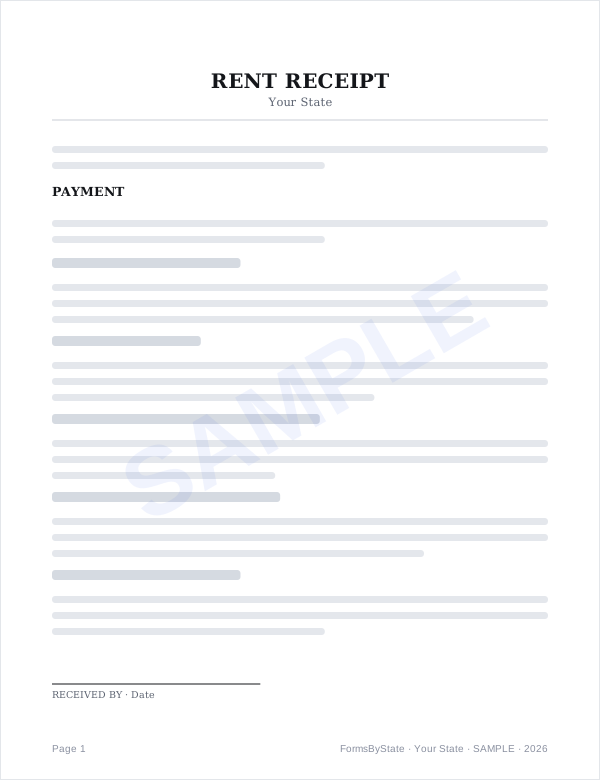 View larger
Sample first page of the Rent Receipt. Your answers fill in the blanks; the clauses required in North Carolina are added automatically.
- Word
This preview updates as you type. Blank fields show as ____ .
What this document covers
- Receipt number and payment date
- Tenant, landlord and rental address
- Amount received and the rent period it covers
- Payment method, with check or reference number
- Late fee or other charges included, itemized
- Balance still due after this payment
- Your state's receipt rule where a statute requires one
- Signature of the person receiving the payment
North Carolina rules that this document follows
| Rent receipt rule | No rent-receipt statute on file — give one anyway, especially for cash |
|---|---|
| Late fee limit | Monthly rent: greater of $15 or 5% of rent; weekly rent: greater of $4 or 5%Source: N.C. Gen. Stat. § 42-46(a) |
| Security deposit limit | 2 weeks' rent for weekly tenancies; 1.5 months for month-to-month; 2 months for leases longer than month-to-month; plus reasonable nonrefundable pet depositSource: N.C. Gen. Stat. § 42-51(b) |
| Statute | North Carolina General Statutes Chapter 42 (Landlord and Tenant) |
Rules current as of 2026-11-16. Statutes change; verify before relying on them.
How North Carolina compares with other states
- Rent receipt rule: No rent-receipt statute on file — give one anyway, especially for cash is the most common rule; 48 of 51 jurisdictions use it.
- Late fee limit: North Carolina is the only state with this rule (Monthly rent: greater of $15 or 5% of rent; weekly rent: greater of $4 or 5%).
- Security deposit limit: North Carolina is the only state with this rule (2 weeks' rent for weekly tenancies; 1.5 months for month-to-month; 2 months for leases…).
How to use this Rent Receipt in North Carolina
Give a receipt for every payment, and always for cash. Keep a copy — together they form the rent ledger you will need for a deposit dispute or an eviction.
If rent is late, send a Late Rent Notice first; if a tenant pays only part, note the balance on the receipt instead of writing "paid in full".
Frequently asked questions
Does a landlord have to give a rent receipt in North Carolina?
We have no rent-receipt statute on file for North Carolina. A receipt is still the simplest proof of payment — give one for every cash payment and whenever a tenant asks.
What should a rent receipt include?
The date, the amount, the tenant's name, the rental address, the rent period covered, the payment method and the signature of the person who received the money. Show any late fee separately and any balance still due.
Should I accept partial rent?
You can, but in some states accepting partial rent after serving a notice can reset or waive an eviction. Write the remaining balance on the receipt and check your state's rules before accepting money after a notice.
Other names
- rent receipt template
- rental receipt
- rent payment receipt
- cash rent receipt
- landlord receipt
- receipt for rent paid
- monthly rent receipt
- rent receipt form
Related documents
- Residential Lease Agreement — North Carolina
- Room Rental Agreement — North Carolina
- Residential Sublease Agreement — North Carolina
- Commercial Lease Agreement — North Carolina
- All North Carolina forms →
Other states
- Alabama
- Alaska
- Arizona
- Arkansas
- California
- Colorado
- Connecticut
- Delaware
- District of Columbia
- Florida
- Georgia
- Hawaii
- Idaho
- Illinois
- Indiana
- Iowa
- Kansas
- Kentucky
- Louisiana
- Maine
- Maryland
- Massachusetts
- Michigan
- Minnesota
- Mississippi
- Missouri
- Montana
- Nebraska
- Nevada
- New Hampshire
- New Jersey
- New Mexico
- New York
- North Dakota
- Ohio
- Oklahoma
- Oregon
- Pennsylvania
- Rhode Island
- South Carolina
- South Dakota
- Tennessee
- Texas
- Utah
- Vermont
- Virginia
- Washington
- West Virginia
- Wisconsin
- Wyoming
FormsByState provides self-help document templates and general information, not legal advice. We are not a law firm. For advice about your situation consult a licensed attorney in your state.
Download your document
Rent Receipt
Need other documents too?
This document
$0 one-time
- PDF + Word, no watermark
- Edit & re-download free for 14 days
Pro — every document
$29 / month
- All 40+ documents, every state
- Unlimited downloads, cancel anytime
or
Secure checkout by Stripe. 30-day money-back guarantee.
Visa · Mastercard · Amex · Apple Pay · Google Pay
Already purchased? Your access is restored automatically on this device or after signing in.