California Construction Subcontractor Agreement (2026)
An agreement between a general contractor and a subcontractor — scope, schedule, subcontract sum, payment and retainage inside your state's prompt-payment and retainage rules, lien waivers, insurance, an indemnity clause limited to what your state's anti-indemnity statute allows, safety, warranty and flow-down of the prime contract.
 View larger
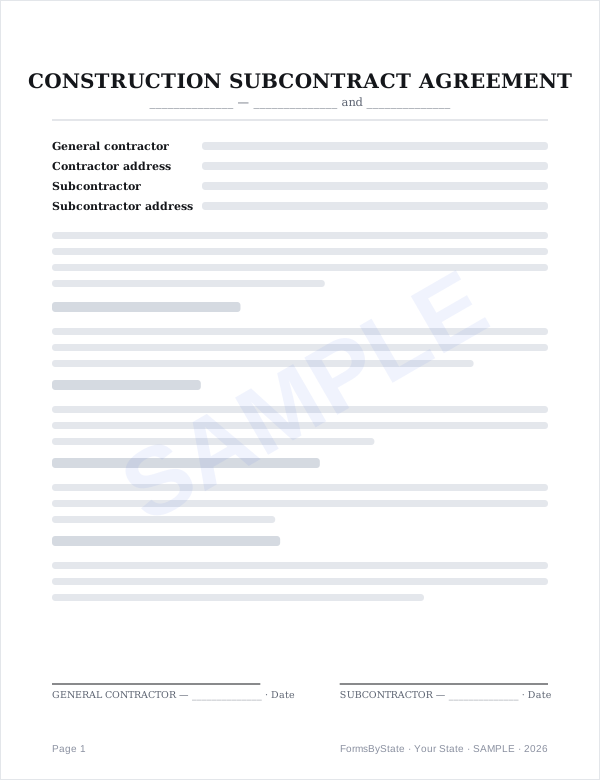
Sample first page of the Construction Subcontractor Agreement. Your answers fill in the blanks; the clauses required in California are added automatically.
- Word
This preview updates as you type. Blank fields show as ____ .
What this document covers
- General contractor, subcontractor and licence numbers
- Project, owner and the prime contract the work flows down from
- Scope of work, materials and equipment responsibility
- Start date and completion date
- Fixed price, unit prices or time and materials
- Payment terms inside your state's prompt-payment statute
- Retainage inside your state's statutory cap
- Pay-when-paid instead of a pay-if-paid clause your state voids
- Lien waiver with every payment
- Insurance, additional insured, indemnity limited by your state's anti-indemnity statute, OSHA safety, warranty and termination
California rules that this document follows
| Prompt payment to subcontractors | The contractor must pay the subcontractor within 7 days after receipt of each progress payment. Late payment carries a penalty of 2% of the amount due per month, in place of interest.Source: Cal. Bus. & Prof. Code § 7108.5 |
|---|---|
| Retainage cap on private work | No statutory cap was confirmed — retainage is whatever the subcontract says, and should never exceed what the owner holds from the general contractor |
| Pay-if-paid clauses | A pay-if-paid clause is unenforceable in California because it is an unlawful waiver of the subcontractor's mechanics lien rights; a pay-when-paid clause that fixes only a reasonable time for payment is still valid.Source: Wm. R. Clarke Corp. v. Safeco Ins. Co., 15 Cal. 4th 882 (1997); Cal. Civ. Code § 8122 |
| Anti-indemnity statute | An indemnity clause in a construction contract is void to the extent it makes the subcontractor answer for the indemnitee's own negligence, whether sole or partial; indemnity for the subcontractor's own share of fault is still allowed.Source: Cal. Civ. Code §§ 2782, 2782.05 |
| Subcontractor lien rights | An unpaid subcontractor may record a mechanics lien against the project; the chapter below sets the preliminary-notice and filing deadlines, which run from the subcontractor's last work, not from the general contractor's.Source: Cal. Civ. Code §§ 8000–8848 (works of improvement) |
| Uninsured subcontractor — workers' compensation | A worker performing work for which a contractor's licence is required, who holds no licence, is an employee of the hiring party, and any worker whose employer carries no coverage is presumed an employee.Source: Cal. Lab. Code §§ 2750.5, 3357 |
| Contractor licensing | Contractors State License Board (CSLB) — A home improvement contract must state the name, business address and license number of the contractor, and every contract must carry the CSLB notice in at least 10-point type (12-point for home improvement and service and repair contracts).Source: Cal. Bus. & Prof. Code §§ 7030, 7159(d)(1) |
Rules current as of 2026-09-14. Statutes change; verify before relying on them.
How to use this Construction Subcontractor Agreement in California
A subcontract is where the money and the risk of a construction project actually get divided. The prime contract sets what the owner owes the general contractor; this document sets what the general contractor owes the trade that does the work — and it is the document a court reads first when a crew walks off, a wall fails or an invoice goes unpaid. This template writes the scope, the schedule, the subcontract sum, the payment terms, the retainage, the insurance, the indemnity, the safety obligations and the flow-down of the prime contract into one agreement, with the rules of California applied to the clauses your state actually regulates.
Payment is the part California has an opinion about. The contractor must pay the subcontractor within 7 days after receipt of each progress payment. Late payment carries a penalty of 2% of the amount due per month, in place of interest. (Cal. Bus. & Prof. Code § 7108.5) No statutory retainage cap was confirmed here, so retainage is a negotiation — hold no more than the owner holds from you, and release it when the work is accepted, not when the whole project closes. On contingent payment, a pay-if-paid clause is unenforceable here (Wm. R. Clarke Corp. v. Safeco Ins. Co., 15 Cal. 4th 882 (1997); Cal. Civ. Code § 8122). Where a pay-if-paid clause would be struck, this template uses pay-when-paid with a reasonable-time cap instead: the owner's payment fixes when the subcontractor is paid, not whether, and the general contractor keeps the cash-flow protection without a clause that evaporates in court.
Risk moves through three clauses, and only one of them is really negotiable. Insurance moves the loss to a carrier: general liability, auto, and workers' compensation for the sub's own employees, with the general contractor and owner as additional insureds on a primary and non-contributory basis, and the certificate in hand before the crew arrives. That last one is not paperwork — in California, a worker performing work for which a contractor's licence is required, who holds no licence, is an employee of the hiring party, and any worker whose employer carries no coverage is presumed an employee. (Cal. Lab. Code §§ 2750.5, 3357) Indemnity picks up what insurance does not, and here the state sets the ceiling: An indemnity clause in a construction contract is void to the extent it makes the subcontractor answer for the indemnitee's own negligence, whether sole or partial; indemnity for the subcontractor's own share of fault is still allowed. (Cal. Civ. Code §§ 2782, 2782.05) This template writes Section 9 to that ceiling automatically, so the clause survives instead of being struck as a whole.
Three habits keep a subcontract out of court. Put every change in writing before the changed work starts, with its price and its effect on the date — verbal extras are the single most common construction claim. Exchange a lien waiver with every payment, conditional with the application and unconditional once the funds clear; the subcontractor's own notice and filing deadlines under Cal. Civ. Code §§ 8000–8848 (works of improvement) run from its last day of work, not from the general contractor's. And check the licence: California licenses contractors (Cal. Bus. & Prof. Code §§ 7030, 7159(d)(1)) and the general contractor's licence does not cover the sub — in a licensing state an unlicensed sub can lose the right to be paid at all.
Frequently asked questions
How fast must a general contractor pay a subcontractor in California?
The contractor must pay the subcontractor within 7 days after receipt of each progress payment. Late payment carries a penalty of 2% of the amount due per month, in place of interest. (Cal. Bus. & Prof. Code § 7108.5)
Is a pay-if-paid clause enforceable in California?
No. A pay-if-paid clause is unenforceable in California because it is an unlawful waiver of the subcontractor's mechanics lien rights; a pay-when-paid clause that fixes only a reasonable time for payment is still valid. (Wm. R. Clarke Corp. v. Safeco Ins. Co., 15 Cal. 4th 882 (1997); Cal. Civ. Code § 8122) A pay-when-paid clause that fixes a reasonable time for payment is still valid, and that is what this template uses.
How much retainage can be held from a subcontractor in California?
No statutory retainage cap was confirmed for California. Retainage is whatever the subcontract says, so negotiate it: 10 percent falling to 5 percent at half completion is common, and it should never exceed what the owner holds from the general contractor.
How far can the indemnity clause reach in California?
An indemnity clause in a construction contract is void to the extent it makes the subcontractor answer for the indemnitee's own negligence, whether sole or partial; indemnity for the subcontractor's own share of fault is still allowed. (Cal. Civ. Code §§ 2782, 2782.05)
What happens if the subcontractor has no workers' compensation?
A worker performing work for which a contractor's licence is required, who holds no licence, is an employee of the hiring party, and any worker whose employer carries no coverage is presumed an employee. (Cal. Lab. Code §§ 2750.5, 3357) In practice that means the general contractor's policy pays for the sub's injured worker, and the premium follows. Collect the certificate before the crew reaches the site.
Does signing a subcontract give up the right to a mechanics lien?
No. The lien is a statutory right under Cal. Civ. Code §§ 8000–8848 (works of improvement), and in most states an advance waiver of it is void. What a subcontractor does give up is time: the preliminary-notice and filing deadlines run from its own last day of work, not from the general contractor's, so calendar them on the day the crew starts.
Other names
- subcontractor agreement
- construction subcontract
- subcontract agreement
- general contractor subcontractor contract
- trade contractor agreement
- sub agreement construction
- subcontractor contract template
- master subcontract agreement
- construction sub agreement
- gc sub contract
Related documents
- Commercial Lease Agreement — California
- Bill of Sale — California
- Promissory Note — California
- Independent Contractor Agreement — California
Other states
- Alabama
- Alaska
- Arizona
- Arkansas
- Colorado
- Connecticut
- Delaware
- District of Columbia
- Florida
- Georgia
- Hawaii
- Idaho
- Illinois
- Indiana
- Iowa
- Kansas
- Kentucky
- Louisiana
- Maine
- Maryland
- Massachusetts
- Michigan
- Minnesota
- Mississippi
- Missouri
- Montana
- Nebraska
- Nevada
- New Hampshire
- New Jersey
- New Mexico
- New York
- North Carolina
- North Dakota
- Ohio
- Oklahoma
- Oregon
- Pennsylvania
- Rhode Island
- South Carolina
- South Dakota
- Tennessee
- Texas
- Utah
- Vermont
- Virginia
- Washington
- West Virginia
- Wisconsin
- Wyoming
FormsByState provides self-help document templates and general information, not legal advice. We are not a law firm. For advice about your situation consult a licensed attorney in your state.
Download your document
Construction Subcontractor Agreement
One-time payment. No subscription, no card on file, no trial.
Single document
$19 one-time
- PDF + Word, no watermark
- Unlimited edits for 90 days
- State-specific disclosures included
7-day pass
$14.99 one-time
- Every document for 7 days
- Unlimited downloads
- Never renews — ends automatically
Pro
$19 /month
- Unlimited documents and downloads
- All 51 jurisdictions
- Cancel in one click
Secure checkout by Stripe. 30-day money-back guarantee.
Already purchased? Your access is restored automatically on this device or after signing in.