North Carolina Eviction Notice (2026)
Notice to pay rent or quit, cure a violation or vacate — with your state's exact notice period, statutory wording, day counting and service rules.
 View larger
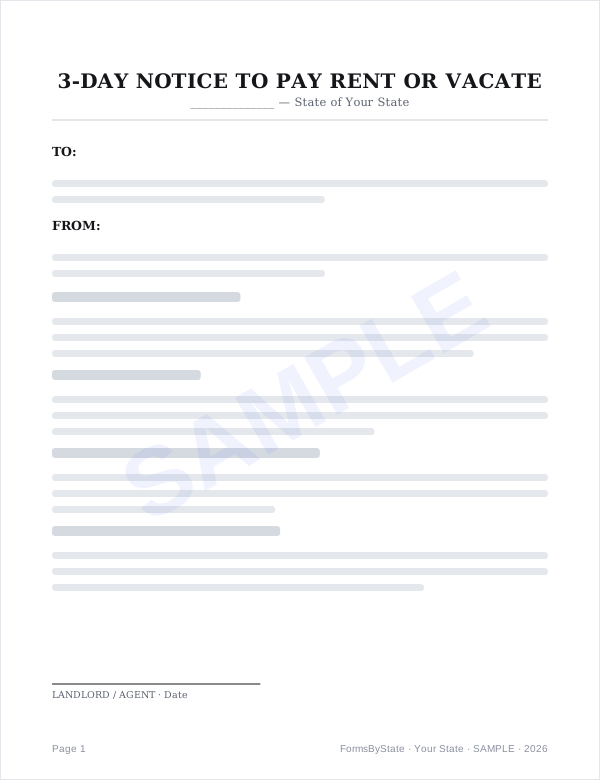
Sample first page of the Eviction Notice. Your answers fill in the blanks; the clauses required in North Carolina are added automatically.
- Word
This preview updates as you type. Blank fields show as ____ .
What this document covers
- Reason: nonpayment, lease violation or unconditional quit
- State notice period and day counting
- Tenants, occupants and premises
- Amount past due and rental periods
- Where, when and how rent may be paid
- Description of the violation and how to cure
- Statutory wording and bold notices your state requires
- CARES Act 30-day rule for covered properties
- Method of service permitted in your state
- Proof of service for the court
North Carolina rules that this document follows
| Nonpayment of rent | 10 days — 10-Day Demand for Rent (Notice to Pay or Quit)Source: N.C. Gen. Stat. § 42-3 |
|---|---|
| Lease violation | No statutory notice required — no statutory right to cureSource: No statutory period; forfeiture clause in lease governs (N.C. Gen. Stat. § 42-26(a)(2)) |
| Unconditional quit | No prior notice required — Criminal activity (drug trafficking, violent crime) — expedited eviction under Article 7Source: N.C. Gen. Stat. § 42-59 et seq.; § 42-26 |
| Permitted service methods | Personal delivery to the tenant; Delivery to a person of suitable age at the premises + first-class mail; Posting on the entry door + first-class mail; Certified mail, return receipt requestedSource: N.C. Gen. Stat. § 42-3 (demand); § 42-29 (summons service) |
| Statute | N.C. Gen. Stat. Chapter 42, Articles 3 and 7 (Summary Ejectment; Expedited Eviction) |
Rules current as of 2026-10-27. Statutes change; verify before relying on them.
How to use this Eviction Notice in North Carolina
Serve the notice exactly as North Carolina law allows and count the days from the day of service — the deadline is the first thing a judge checks; this generator does the counting for you. Do not include late fees in a pay-or-quit amount unless your state permits it. If the tenant pays the full amount in time, the notice is satisfied.
Keep a copy of the notice and the signed proof of service; you will attach both to the court complaint if the tenant does not comply.
Frequently asked questions
How many days' notice for nonpayment of rent in North Carolina?
10 days (10-Day Demand for Rent (Notice to Pay or Quit)), N.C. Gen. Stat. § 42-3. Properties covered by the CARES Act require at least 30 days.
How must the notice be delivered?
Personal delivery to the tenant; Delivery to a person of suitable age at the premises + first-class mail; Posting on the entry door + first-class mail; Certified mail, return receipt requested. N.C. Gen. Stat. § 42-3 (demand); § 42-29. Keep the completed proof of service — the court will ask for it.
Can I change the locks or shut off utilities instead?
No. Self-help eviction is illegal in every state and exposes the landlord to damages. After the notice period expires you must file an eviction case in court.
Other names
- notice to quit
- pay or quit notice
- 3 day notice
- notice to vacate
- eviction letter
- notice to cure or quit
- late rent notice
- demand for possession
Related documents
- Residential Lease Agreement — North Carolina
- Room Rental Agreement — North Carolina
- Residential Sublease Agreement — North Carolina
- Commercial Lease Agreement — North Carolina
- All North Carolina forms →
Other states
- Alabama
- Alaska
- Arizona
- Arkansas
- California
- Colorado
- Connecticut
- Delaware
- District of Columbia
- Florida
- Georgia
- Hawaii
- Idaho
- Illinois
- Indiana
- Iowa
- Kansas
- Kentucky
- Louisiana
- Maine
- Maryland
- Massachusetts
- Michigan
- Minnesota
- Mississippi
- Missouri
- Montana
- Nebraska
- Nevada
- New Hampshire
- New Jersey
- New Mexico
- New York
- North Dakota
- Ohio
- Oklahoma
- Oregon
- Pennsylvania
- Rhode Island
- South Carolina
- South Dakota
- Tennessee
- Texas
- Utah
- Vermont
- Virginia
- Washington
- West Virginia
- Wisconsin
- Wyoming
FormsByState provides self-help document templates and general information, not legal advice. We are not a law firm. For advice about your situation consult a licensed attorney in your state.
Download your document
Eviction Notice
$19 one-time
Lawyer sites charge $35–$139 for the same document
- PDF + Word, no watermark
- Edit & re-download free for 14 days
- State-specific disclosures included
Secure checkout by Stripe. 30-day money-back guarantee.
Visa · Mastercard · Amex · Apple Pay · Google Pay
Need more than one document?
Landlord?
Already purchased? Your access is restored automatically on this device or after signing in.