Oregon Residential Lease Agreement (2026)
A complete, state-specific lease for a house, apartment or condo with every disclosure your state requires.
 View larger
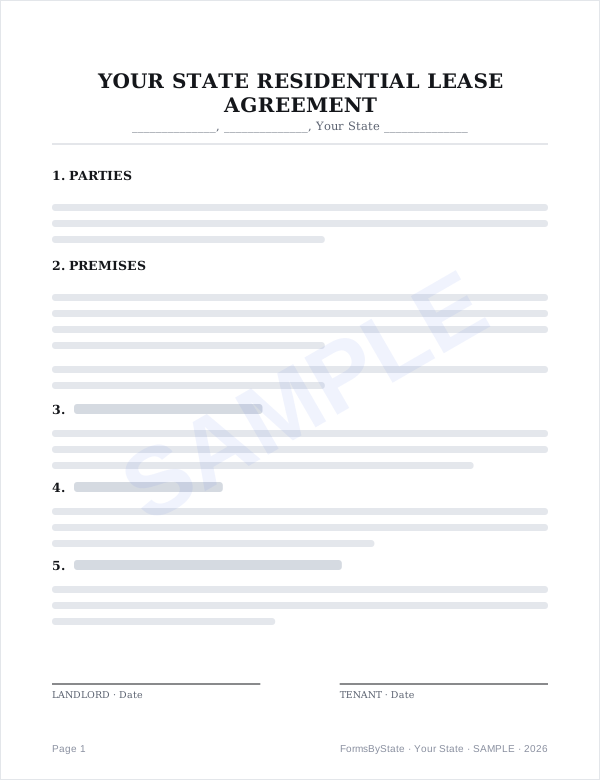
Sample first page of the Residential Lease Agreement. Your answers fill in the blanks; the clauses required in Oregon are added automatically.
- Word
This preview updates as you type. Blank fields show as ____ .
What this document covers
- Parties, occupants and joint liability
- Premises, furnishings and parking
- Fixed or month-to-month term and holdover
- Rent, due date, payment methods and late fees
- Security deposit cap, holding and return deadline
- Who pays which utilities
- Maintenance, repairs and landlord entry notice
- Pets, smoking, subletting and renter's insurance
- Early termination and move-out
- State disclosures and federal lead-paint notice
Oregon rules that this document follows
| Security deposit limit | No statutory limitSource: No statutory limit statewide (ORS 90.300); Portland caps at 1 month (PCC 30.01.087) |
|---|---|
| Deposit return deadline | 31 days after move-outSource: ORS 90.300(13) |
| Interest on deposit | Not requiredSource: ORS 90.300 (no state requirement; Portland requires interest if held in interest-bearing account) |
| Late fees | Reasonable flat fee, or up to 5% of monthly rent per 5-day late period, or daily fee up to 6% of the reasonable flat fee; must be in written leaseSource: ORS 90.260 |
| Landlord entry notice | 24 hoursSource: ORS 90.322(1)(f) |
| Notice to end month-to-month | Landlord 30 days / Tenant 30 daysSource: ORS 90.427 (landlord: 30 days without cause during first year only; thereafter cause or qualifying reason with 90 days' notice) |
| Just cause to end tenancy | Required after 12 monthsSource: ORS 90.427 |
| Rent increase rules | 7% + CPI or 10%, whichever lower (2026 cap: 9.5%); no increase in first year; 90 days' written notice; buildings under 15 years old exemptSource: ORS 90.323; ORS 90.324 |
| Required disclosures | Lead-Based Paint Disclosure (pre-1978 housing); Manager/Owner Identification; Smoke and CO Alarm Instructions; 100-Year Flood Plain Notice; Smoking Policy; Recycling Information; Utility and Service Charges; Security Deposit Receipt; Outstanding Notices and Pending Suits; Portland Condition Report / Renter Relocation NoticeSource: Oregon Residential Landlord and Tenant Act, ORS Chapter 90 |
Rules current as of 2026-10-27. Statutes change; verify before relying on them.
How to use this Residential Lease Agreement in Oregon
A residential lease in Oregon should identify every adult tenant, describe the premises, state the term, the rent and how it is paid, the security deposit and how it will be returned, who pays which utilities, the rules on pets, smoking and subletting, and the disclosures Oregon law requires. This generator walks you through each of those items in order, checks the deposit and late fee against Oregon's statutory caps, and drafts the clauses for you.
Before you start, gather: the legal names and mailing addresses of the landlord and all tenants, the property address and the number of units in the building, the move-in date, the rent amount and due day, the deposit amount and the bank where it will be held (some states require this), whether the building was built before 1978 (federal lead-paint rule), and the answers to your state's disclosure questions (for example whether the property is in a FEMA flood zone — check msc.fema.gov).
After you preview the document, download the PDF, have every adult tenant and the landlord sign (electronic signatures are valid), give each party a copy together with every attachment listed at the end of the lease, and complete a move-in inspection checklist with photos. Keep the signed lease for at least four years after the tenancy ends.
Frequently asked questions
How much security deposit can a landlord charge in Oregon?
Oregon has no statutory cap on security deposits (No statutory limit statewide; Portland caps at 1 month); the amount must be stated in the lease and returned per statute.
When must the deposit be returned in Oregon?
Within 31 days after the tenant moves out, with an itemized statement of deductions (ORS 90.300(13)).
Does this lease include the disclosures Oregon requires?
Yes. The Disclosures section asks you the yes/no questions each Oregon statute requires (for example flood zone, sprinklers, mold or bed bugs) and prints the actual statutory statement — in bold or larger type where the law demands it — with its citation, plus the federal lead-paint notice for pre-1978 buildings. Forms that must be separate documents are listed as attachments.
Is this lease legally binding once signed?
A written lease signed by landlord and all adult tenants is an enforceable contract in Oregon. Electronic signatures are valid under the federal ESIGN Act and the state UETA. No notarization is required for a residential lease.
Can I use this for a month-to-month rental?
Yes — choose 'Month-to-month' in the Term step. The tenant's notice period is set to Oregon's statutory minimum, and the lease states that the landlord may end the tenancy only for a cause permitted by ORS 90.427.
Other names
- rental agreement
- residential tenancy agreement
- apartment lease
- house rental contract
- tenancy agreement
- lease contract
- rental contract
Related documents
- Room Rental Agreement — Oregon
- Residential Sublease Agreement — Oregon
- Commercial Lease Agreement — Oregon
- Rental Application — Oregon
- All Oregon forms →
Other states
- Alabama
- Alaska
- Arizona
- Arkansas
- California
- Colorado
- Connecticut
- Delaware
- District of Columbia
- Florida
- Georgia
- Hawaii
- Idaho
- Illinois
- Indiana
- Iowa
- Kansas
- Kentucky
- Louisiana
- Maine
- Maryland
- Massachusetts
- Michigan
- Minnesota
- Mississippi
- Missouri
- Montana
- Nebraska
- Nevada
- New Hampshire
- New Jersey
- New Mexico
- New York
- North Carolina
- North Dakota
- Ohio
- Oklahoma
- Pennsylvania
- Rhode Island
- South Carolina
- South Dakota
- Tennessee
- Texas
- Utah
- Vermont
- Virginia
- Washington
- West Virginia
- Wisconsin
- Wyoming
FormsByState provides self-help document templates and general information, not legal advice. We are not a law firm. For advice about your situation consult a licensed attorney in your state.
Download your document
Residential Lease Agreement
$19 one-time
Lawyer sites charge $35–$139 for the same document
- PDF + Word, no watermark
- Edit & re-download free for 14 days
- State-specific disclosures included
Secure checkout by Stripe. 30-day money-back guarantee.
Visa · Mastercard · Amex · Apple Pay · Google Pay
Need more than one document?
Landlord?
Already purchased? Your access is restored automatically on this device or after signing in.