Residential Lease Agreement
A complete, state-specific lease for a house, apartment or condo with every disclosure your state requires.
 View larger
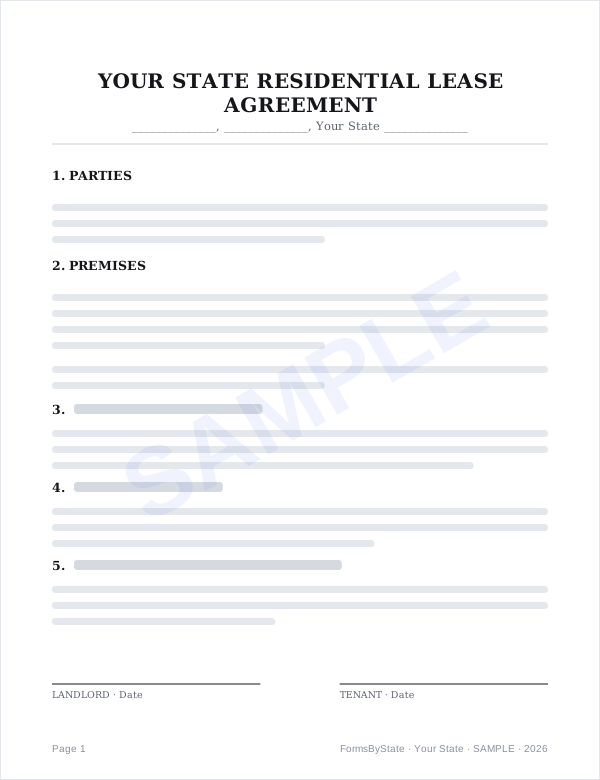
Sample first page of the Residential Lease Agreement. Your answers fill in the blanks; the clauses required in your state are added automatically.
- Word
Choose your state
Select a state to load the correct statutory rules.
- Alabama
- Alaska
- Arizona
- Arkansas
- California
- Colorado
- Connecticut
- Delaware
- District of Columbia
- Florida
- Georgia
- Hawaii
- Idaho
- Illinois
- Indiana
- Iowa
- Kansas
- Kentucky
- Louisiana
- Maine
- Maryland
- Massachusetts
- Michigan
- Minnesota
- Mississippi
- Missouri
- Montana
- Nebraska
- Nevada
- New Hampshire
- New Jersey
- New Mexico
- New York
- North Carolina
- North Dakota
- Ohio
- Oklahoma
- Oregon
- Pennsylvania
- Rhode Island
- South Carolina
- South Dakota
- Tennessee
- Texas
- Utah
- Vermont
- Virginia
- Washington
- West Virginia
- Wisconsin
- Wyoming
Compare Residential Lease Agreement rules in all 50 states
Key statutory numbers side by side. Click a column header to sort, or type to find your state — each state name opens the state-specific generator.
| Alabama | one month's rent | 60 days after move-out | No statutory cap; must be reasonable and stated in the lease | 48 hours | Landlord 30 days / Tenant 30 days |
|---|---|---|---|---|---|
| Alaska | 2 months' rent | 14 days after move-out | No statutory cap; must be reasonable and stated in the lease | 24 hours | Landlord 30 days / Tenant 30 days |
| Arizona | 1.5 months' rent | 14 days after move-out | No statutory cap; must be reasonable and stated in the lease | 48 hours | Landlord 30 days / Tenant 30 days |
| Arkansas | 2 months' rent | 60 days after move-out | No statutory cap; must be reasonable and stated in the lease | No statutory minimum (lease governs; reasonable notice) | Landlord 30 days / Tenant 30 days |
| California | one month's rent (2 months for small owner-landlords) | 21 days after move-out | Must be a reasonable estimate of landlord's actual damages; no statutory percentage cap | 24 hours | Landlord 30/60 days by length of tenancy / Tenant 30 days |
| Colorado | 2 months' rent | 30 days after move-out | Greater of $50 or 5% of the past-due rent; may not be charged unless disclosed in lease | No statutory minimum (lease governs; reasonable notice) | Landlord 21 days / Tenant 21 days |
| Connecticut | 2 months' rent | 21 days after move-out | Lesser of $5/day up to $50, or 5% of the delinquent rent | No statutory minimum (lease governs; reasonable notice) | Landlord 3 days / Tenant 3 days |
| Delaware | one month's rent | 20 days after move-out | Max 5% of monthly rent; landlord must maintain office in county or grace is 8 days | 48 hours | Landlord 60 days / Tenant 60 days |
| District of Columbia | one month's rent | 45 days after move-out | Max 5% of monthly rent | 48 hours | Landlord: cause required / Tenant 30 days |
| Florida | No statutory limit | 15 days after move-out (claim notice within 30 days if deducting) | No statutory cap; must be reasonable and stated in the lease | 24 hours (7:30 a.m. and 8:00 p.m.) | Landlord 30 days / Tenant 30 days |
| Georgia | 2 months' rent | 30 days after move-out | No statutory cap; must be reasonable and stated in the lease | No statutory minimum (lease governs; reasonable notice) | Landlord 60 days / Tenant 30 days |
| Hawaii | one month's rent | 14 days after move-out | Max 8% of the rent due | 48 hours | Landlord 45 days / Tenant 28 days |
| Idaho | No statutory limit | 21 days after move-out | No statutory cap; must be reasonable and stated in the lease | No statutory minimum (lease governs; reasonable notice) | Landlord 30 days / Tenant 30 days |
| Illinois | No statutory limit | 45 days after move-out | No statewide cap; Chicago: $10 on first $500 of rent plus 5% of rent above $500 | No statutory minimum (lease governs; reasonable notice) | Landlord 30 days / Tenant 30 days |
| Indiana | No statutory limit | 45 days after move-out | No statutory cap; must be reasonable and stated in the lease | No statutory minimum (lease governs; reasonable notice) | Landlord 30 days / Tenant 30 days |
| Iowa | 2 months' rent | 30 days after move-out | Rent ≤ $700/month: max $12/day, $60/month; rent > $700/month: max $20/day, $100/month | 24 hours | Landlord 30 days / Tenant 30 days |
| Kansas | one month's rent | 30 days after move-out | No statutory cap; must be reasonable and stated in the lease | No statutory minimum (lease governs; reasonable notice) | Landlord 30 days / Tenant 30 days |
| Kentucky | No statutory limit | 60 days after move-out | No statutory cap; must be reasonable and stated in the lease | 48 hours | Landlord 30 days / Tenant 30 days |
| Louisiana | No statutory limit | 30 days after move-out | No statutory cap; must be reasonable and stated in the lease | No statutory minimum (lease governs; reasonable notice) | Landlord 10 days / Tenant 10 days |
| Maine | 2 months' rent | 30 days after move-out | Max 4% of the monthly rent; must be disclosed in writing at lease signing | 24 hours | Landlord 30 days / Tenant 30 days |
| Maryland | one month's rent | 45 days after move-out | Max 5% of the rent due per period | No statutory minimum (lease governs; reasonable notice) | Landlord 60 days / Tenant 30 days |
| Massachusetts | one month's rent | 30 days after move-out | No cap; no late fee or interest may be charged until rent is 30 days late | No statutory minimum (lease governs; reasonable notice) | Landlord 30 days / Tenant 30 days |
| Michigan | 1.5 months' rent | 30 days after move-out | No statutory cap; must be reasonable and stated in the lease | No statutory minimum (lease governs; reasonable notice) | Landlord 30 days / Tenant 30 days |
| Minnesota | No statutory limit | 21 days after move-out | Max 8% of the overdue rent payment; must be in written lease | 24 hours (8:00 a.m. and 8:00 p.m.) | Landlord 30 days / Tenant 30 days |
| Mississippi | No statutory limit | 45 days after move-out | No statutory cap; must be reasonable and stated in the lease | No statutory minimum (lease governs; reasonable notice) | Landlord 30 days / Tenant 30 days |
| Missouri | 2 months' rent | 30 days after move-out | No statutory cap; must be reasonable and stated in the lease | No statutory minimum (lease governs; reasonable notice) | Landlord 30 days / Tenant 30 days |
| Montana | No statutory limit | 10 days after move-out | No statutory cap; must be reasonable and stated in the lease | 24 hours | Landlord 30 days / Tenant 30 days |
| Nebraska | one month's rent | 14 days after move-out | No statutory cap; must be reasonable and stated in the lease | 24 hours | Landlord 30 days / Tenant 30 days |
| Nevada | 3 months' rent | 30 days after move-out | Max 5% of the periodic rent | 24 hours | Landlord 30 days / Tenant 30 days |
| New Hampshire | one month's rent | 30 days after move-out | No statutory cap; must be reasonable and stated in the lease | No statutory minimum (lease governs; reasonable notice) | Landlord 30 days / Tenant 30 days |
| New Jersey | 1.5 months' rent | 30 days after move-out | No cap; 5-business-day grace period applies only to tenants receiving Social… | 24 hours | Landlord: cause required / Tenant 30 days |
| New Mexico | one month's rent | 30 days after move-out | Max 10% of the rent for the rental period | 24 hours | Landlord 30 days / Tenant 30 days |
| New York | one month's rent | 14 days after move-out | Lesser of $50 or 5% of the monthly rent | No statutory minimum (lease governs; reasonable notice) | Landlord 30/60/90 days by length of tenancy / Tenant 30 days |
| North Carolina | 2 months' rent | 30 days after move-out | Monthly rent: greater of $15 or 5% of rent; weekly rent: greater of $4 or 5% | No statutory minimum (lease governs; reasonable notice) | Landlord 7 days / Tenant 7 days |
| North Dakota | one month's rent | 30 days after move-out | No statutory cap; must be reasonable and stated in the lease | No statutory minimum (lease governs; reasonable notice) | Landlord 30 days / Tenant 30 days |
| Ohio | No statutory limit | 30 days after move-out | No statutory cap; must be reasonable and stated in the lease | 24 hours | Landlord 30 days / Tenant 30 days |
| Oklahoma | No statutory limit | 45 days after move-out | No statutory cap; must be reasonable and stated in the lease | 24 hours | Landlord 30 days / Tenant 30 days |
| Oregon | No statutory limit | 31 days after move-out | Reasonable flat fee, or up to 5% of monthly rent per 5-day late period, or daily fee… | 24 hours | Landlord 30 days / Tenant 30 days |
| Pennsylvania | 2 months' rent | 30 days after move-out | No statutory cap; must be reasonable and stated in the lease | No statutory minimum (lease governs; reasonable notice) | Landlord 15 days / Tenant 15 days |
| Rhode Island | one month's rent | 20 days after move-out | No cap; late fee may not be charged until rent is 15 days late | 48 hours | Landlord 30 days / Tenant 30 days |
| South Carolina | No statutory limit | 30 days after move-out | No statutory cap; must be reasonable and stated in the lease | 24 hours | Landlord 30 days / Tenant 30 days |
| South Dakota | one month's rent | 14 days after move-out | No statutory cap; must be reasonable and stated in the lease | 24 hours | Landlord 30 days / Tenant 15 days |
| Tennessee | No statutory limit | 30 days after move-out | Max 10% of the amount past due | 24 hours | Landlord 30 days / Tenant 30 days |
| Texas | No statutory limit | 30 days after move-out | Max 12% of monthly rent for buildings with 4 or fewer units; 10% for 5+ units; fee… | No statutory minimum (lease governs; reasonable notice) | Landlord 30 days / Tenant 30 days |
| Utah | No statutory limit | 30 days after move-out | Max greater of $75 or 10% of the monthly rent | 24 hours | Landlord 15 days / Tenant 15 days |
| Vermont | No statutory limit | 14 days after move-out | No statutory cap; must be reasonable and stated in the lease | 48 hours (9:00 a.m. and 9:00 p.m.) | Landlord 60/90 days by length of tenancy / Tenant 30 days |
| Virginia | 2 months' rent | 45 days after move-out | Max lesser of 10% of the periodic rent or 10% of the remaining balance due | 72 hours | Landlord 30 days / Tenant 30 days |
| Washington | No statutory limit | 30 days after move-out | Max 1.5% of the tenant's total monthly rent (HB 1217, 2025); no fee if paid within 5… | 48 hours | Landlord: cause required / Tenant 20 days |
| West Virginia | No statutory limit | 60 days after move-out | No statutory cap; must be reasonable and stated in the lease | No statutory minimum (lease governs; reasonable notice) | Landlord 30 days / Tenant 30 days |
| Wisconsin | No statutory limit | 21 days after move-out | No statutory cap; must be reasonable and stated in the lease | 12 hours | Landlord 28 days / Tenant 28 days |
| Wyoming | No statutory limit | 30 days after move-out | No statutory cap; must be reasonable and stated in the lease | No statutory minimum (lease governs; reasonable notice) | Landlord: cause required / Tenant: see statute |
No state matches — try the two-letter code.
Values are shortened; open the state page for the full rule and its citation.
What this document covers
- Parties, occupants and joint liability
- Premises, furnishings and parking
- Fixed or month-to-month term and holdover
- Rent, due date, payment methods and late fees
- Security deposit cap, holding and return deadline
- Who pays which utilities
- Maintenance, repairs and landlord entry notice
- Pets, smoking, subletting and renter's insurance
- Early termination and move-out
- State disclosures and federal lead-paint notice
How to use this Residential Lease Agreement in US
A residential lease in your state should identify every adult tenant, describe the premises, state the term, the rent and how it is paid, the security deposit and how it will be returned, who pays which utilities, the rules on pets, smoking and subletting, and the disclosures your state law requires. This generator walks you through each of those items in order, checks the deposit and late fee against your state's statutory caps, and drafts the clauses for you.
Before you start, gather: the legal names and mailing addresses of the landlord and all tenants, the property address and the number of units in the building, the move-in date, the rent amount and due day, the deposit amount and the bank where it will be held (some states require this), whether the building was built before 1978 (federal lead-paint rule), and the answers to your state's disclosure questions (for example whether the property is in a FEMA flood zone — check msc.fema.gov).
After you preview the document, download the PDF, have every adult tenant and the landlord sign (electronic signatures are valid), give each party a copy together with every attachment listed at the end of the lease, and complete a move-in inspection checklist with photos. Keep the signed lease for at least four years after the tenancy ends.
Other names
- rental agreement
- residential tenancy agreement
- apartment lease
- house rental contract
- tenancy agreement
- lease contract
- rental contract
Related documents
Blank Residential Lease Agreement forms by state
free, no account · PDF + Word
Choose your state ▾
- Alabama
- Alaska
- Arizona
- Arkansas
- California
- Colorado
- Connecticut
- Delaware
- District of Columbia
- Florida
- Georgia
- Hawaii
- Idaho
- Illinois
- Indiana
- Iowa
- Kansas
- Kentucky
- Louisiana
- Maine
- Maryland
- Massachusetts
- Michigan
- Minnesota
- Mississippi
- Missouri
- Montana
- Nebraska
- Nevada
- New Hampshire
- New Jersey
- New Mexico
- New York
- North Carolina
- North Dakota
- Ohio
- Oklahoma
- Oregon
- Pennsylvania
- Rhode Island
- South Carolina
- South Dakota
- Tennessee
- Texas
- Utah
- Vermont
- Virginia
- Washington
- West Virginia
- Wisconsin
- Wyoming
FormsByState provides self-help document templates and general information, not legal advice. We are not a law firm. For advice about your situation consult a licensed attorney in your state.